




Largest Tablet in the World: How Big Can a Tablet Actually Get in 2026?

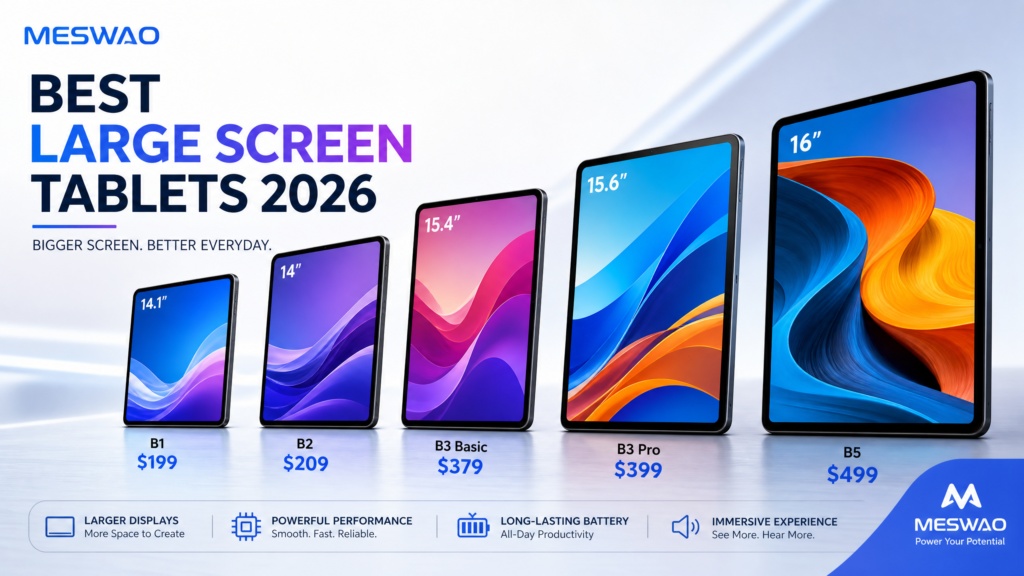
The largest tablet in the world in 2026 is a 16-inch Android slate — and as of October 2026 there are exactly two of them on sale: the Acer Iconia A16 and the MESWAO B5, joined by its B5 Basic sibling. All three use a 16-inch 16:10 panel with about 742 cm² of glass, which is roughly 19 percent more surface area than a sheet of A4 paper.
Above 16 inches, nothing is sold as a tablet. There is no 17-inch tablet on the market, and the next size up — 20 inches and beyond — belongs to portable monitors and commercial displays: a different product category with different power, mounting and input assumptions. So if you only want the one-line answer, it is this: 16 inches is the ceiling, and it has been since 2026.
The more interesting question is why. A panel maker can build glass far larger than 16 inches; the ceiling is not a manufacturing limit. It is the point where weight, aspect ratio, freight economics and demand all stop pointing in the same direction — and that is what the rest of this page unpacks, after ranking every large tablet on sale today by actual screen area rather than by a diagonal number alone.
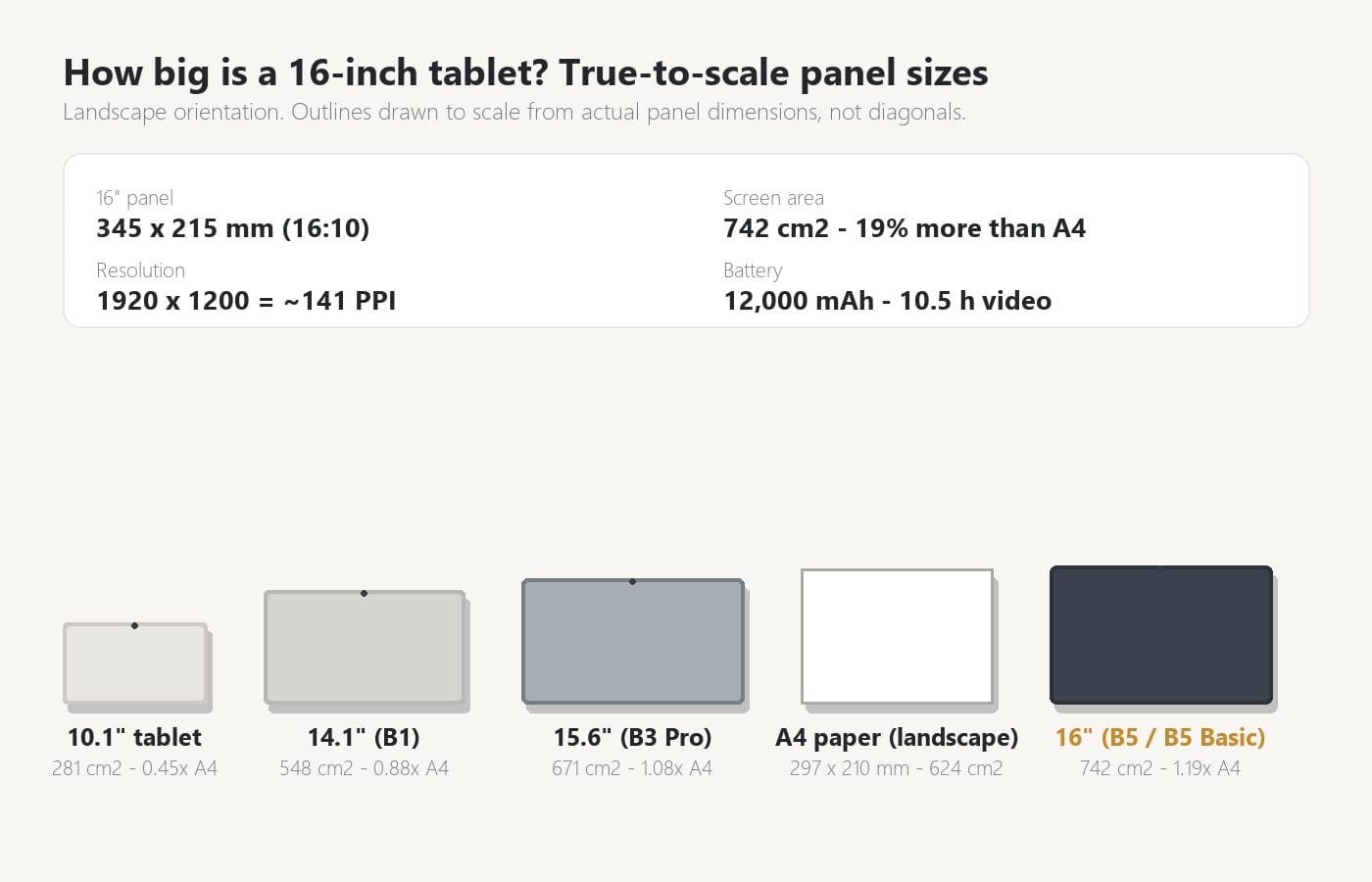
The Size Ranking: Largest Tablets in the World (2026)
Diagonal size is the number everybody quotes and the number that misleads most often. Two screens with the same diagonal can differ in area by more than 20 percent, because area depends on the diagonal and the aspect ratio. A 15.6-inch 16:9 panel and a 15.6-inch 4:3 panel are not the same amount of glass, even though the spec sheet calls both of them “15.6-inch”.
The table below ranks the current tablet market by panel area. Each figure is calculated from the stated diagonal and aspect ratio using area = width × height (1 in² = 6.4516 cm²), then cross-checked against the area figures published by third-party size trackers. Panel measurements are rounded to the nearest millimetre.
| Rank | Tablet | Screen | Aspect | Panel area | Panel (mm) | Platform |
|---|---|---|---|---|---|---|
| 1 | MESWAO B5 / B5 Basic | 16.0 in | 16:10 | 742 cm² | 345 × 215 | Android |
| 2 | Acer Iconia A16 | 16.0 in | 16:10 | 742 cm² | 345 × 215 | Android |
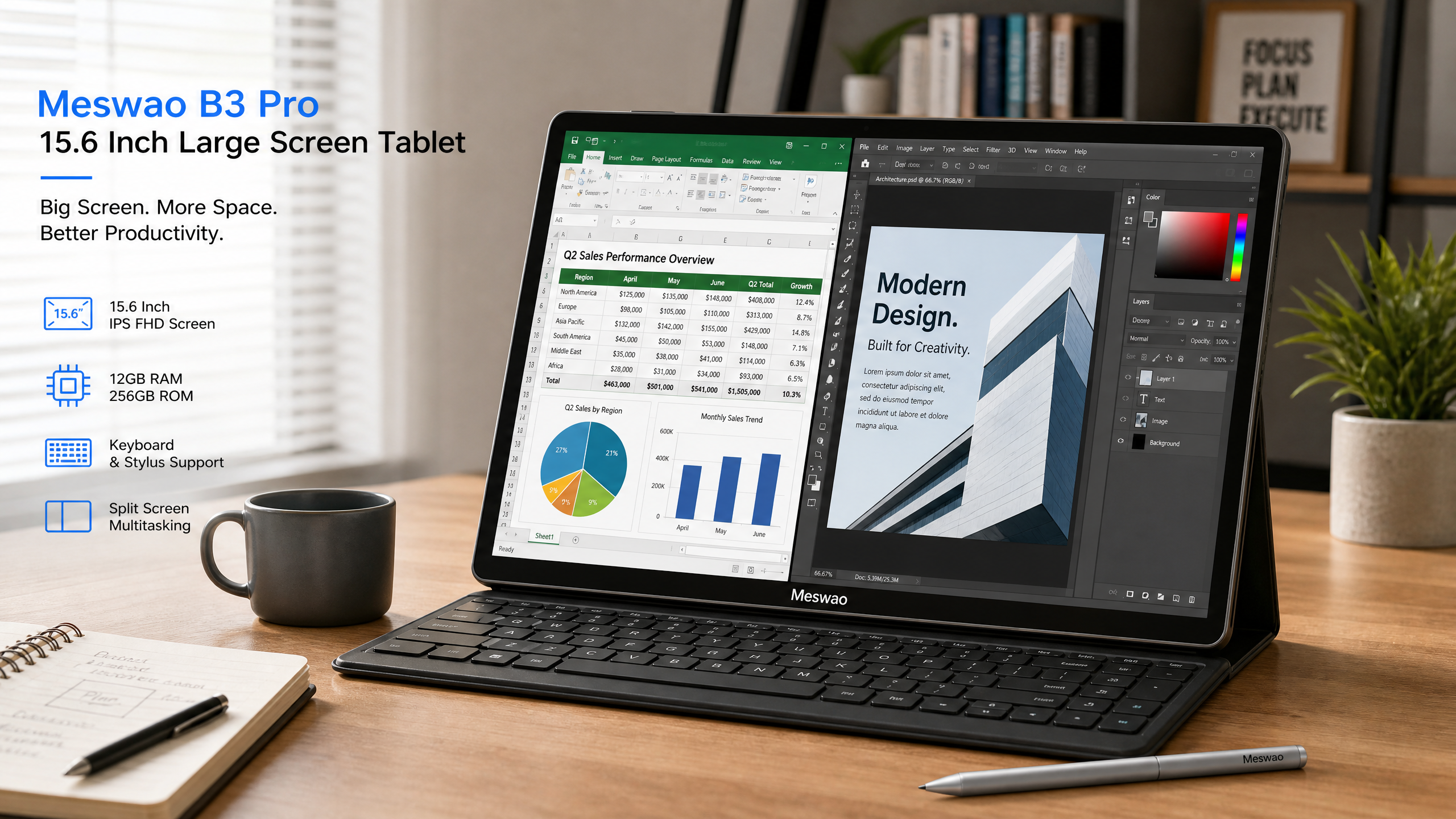
| 3 | MESWAO B3 Pro | 15.6 in | 16:9 | 671 cm² | 345 × 194 | Android |
| 4 | MESWAO B4 | 15.4 in | 16:9 | 654 cm² | 341 × 192 | Android |
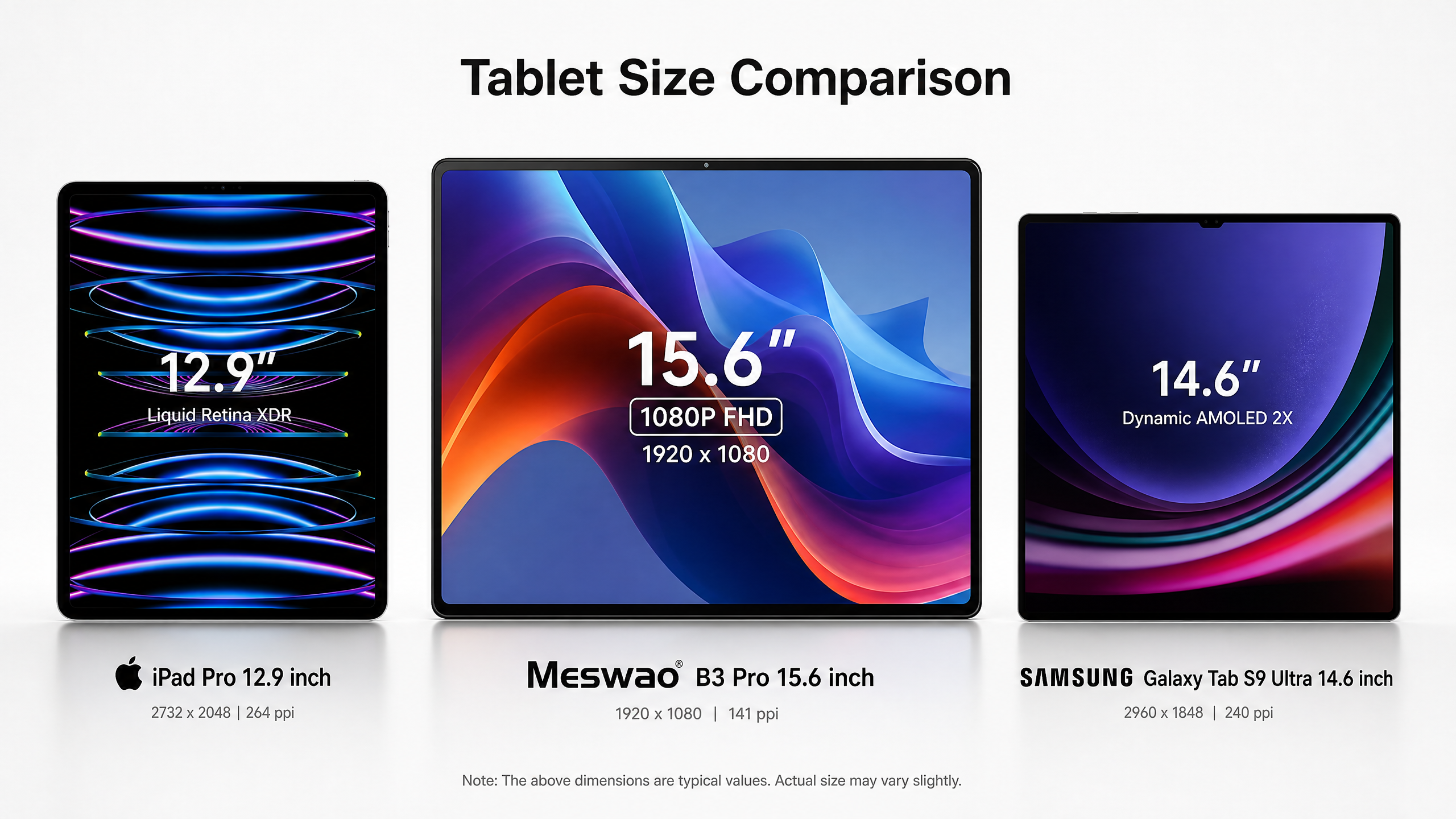
| 5 | Samsung Galaxy Tab S11 Ultra | 14.6 in | 16:10 | 618 cm² | 314 × 197 | Android |
| 6 | MESWAO B1 | 14.1 in | 16:9 | 548 cm² | 312 × 176 | Android |
| 7 | MESWAO B2 | 14.0 in | 16:9 | 540 cm² | 310 × 174 | Android |
| 8 | Apple iPad Pro 13 | 13.0 in | 4:3 | 523 cm² | 264 × 198 | iPadOS |
One A4 sheet is 623.7 cm² — the reference point used throughout this page.
Two things stand out from that ranking. First, the two 16-inch models at the top are roughly 11 percent larger in area than the 15.6-inch slate that used to be the biggest Android tablet you could buy, and about 19 percent larger than an A4 sheet. Second, Apple’s largest tablet does not appear in the top five by area: the 13-inch iPad Pro uses a squarer 4:3 panel, so it lands below even a 14.1-inch 16:9 Android tablet. Diagonal marketing and usable glass are two different numbers.
Note also what the table measures. These are panel dimensions, not device dimensions — a 16-inch display sits inside a chassis roughly 25 mm wider and taller than the glass itself. For comparison, the Acer Iconia A16 measures 369.5 × 240.2 mm as a complete device. If you want the same comparison with 10.1, 13, 14.1, 15.6 and 16-inch panels lined up with their inch and centimetre dimensions side by side, see our full screen size comparison.
Methodology note: this ranking covers tablets that ship with their own battery, processor and touch-first operating system. Pen displays, drawing tablets that need a connected computer, and rugged industrial slates are excluded, because they are not competing for the same buyer. Where a manufacturer publishes a panel area figure it is used directly; otherwise the area is computed from the published diagonal and aspect ratio. Differences of one or two square centimetres between sources are normal, since panel specifications are rounded.
Why 16 Inches Is the Ceiling
Four forces converge at roughly this point in the market, and none of them is about manufacturing capability.
Panel supply. The tablet panel pipeline is built around 10 to 13 inches, because that is where the volume is. Anything past 13 inches is usually borrowed from notebook or monitor glass rather than developed specifically for tablets. That is why the 15.6-inch and 16-inch tiers feel like a step into a different supply chain — and why the number of models at those sizes stays in the single digits while there are dozens of 11-inch tablets.
Weight and handling. The Acer Iconia A16 already weighs 980 g, more than most 13-inch ultraportable laptops. Push the panel past 16 inches and you are past 1.2 kg, at which point the device stops being something you hold and becomes something you prop up. Every 16-inch tablet on the market ships with a kickstand or expects a stand, and that is not a coincidence.
The aspect ratio trade-off. 16:9 gives you a cinematic frame for film and series; 16:10 gives you more vertical room for documents, web pages and split-screen work. The B5 and B5 Basic use 16:10, which is exactly why the 16-inch panel is the same 345 mm wide as the 15.6-inch 16:9 panel in the B3 Pro, and simply 21 mm taller. At the top of the market, the extra inch buys height, not width.
Freight and breakage. A 16-inch glass panel still fits into a hand-carried box, but it sits close to the point where shipping cost per unit starts rising faster than the price premium customers will accept. Add the damage rate on large glass and the margin maths stops working before the engineering does.
Put together, these four constraints explain why the largest tablet in the world has been stuck in the 14 to 16-inch band for years while phone screens grew every single season.
What would have to change for an 18-inch tablet to appear? Three things, probably at once: a cheaper large-panel source, a chassis light enough to be carried in one hand at under a kilogram, and enough demand to justify a production run. We do not think any of the three is close. That is why the honest 2026 answer is that 16 inches is not just today’s ceiling — it is likely to be next year’s ceiling too.
How Big Is 16 Inches, Really?
Sixteen inches is the diagonal, which is 40.6 cm. What you actually look at all day is the panel rectangle: 345 mm wide by 215 mm tall.
An A4 sheet is 210 × 297 mm, or 623.7 cm². A 16-inch 16:10 panel is 742 cm², about 19 percent more area. Measured against US Letter (216 × 279 mm, 603 cm²) the same panel is 23 percent larger, which is the figure some third-party size trackers publish. Both are correct — they simply use a different sheet of paper as the yardstick. If you see a percentage quoted for a 16-inch tablet, check which paper it refers to.
Comparing the 16-inch panel to the sizes it replaced is where the numbers get counter-intuitive:
| Panel | Aspect | Width | Height | Area |
|---|---|---|---|---|
| 13.0 in | 4:3 | 264 mm | 198 mm | 523 cm² |
| 14.1 in | 16:9 | 312 mm | 176 mm | 548 cm² |
| 15.6 in | 16:9 | 345 mm | 194 mm | 671 cm² |
| 16.0 in | 16:10 | 345 mm | 215 mm | 742 cm² |
The 15.6-inch and 16-inch panels are the same width, to the millimetre. The entire difference — about 71 cm² of extra glass, roughly 11 percent more area — is height. If you have used a 15.6-inch 16:9 tablet of this class, a 16-inch 16:10 model will feel almost identical side to side and noticeably deeper top to bottom. That matters for reading, for PDFs and for split-screen work, and it matters much less for widescreen video.
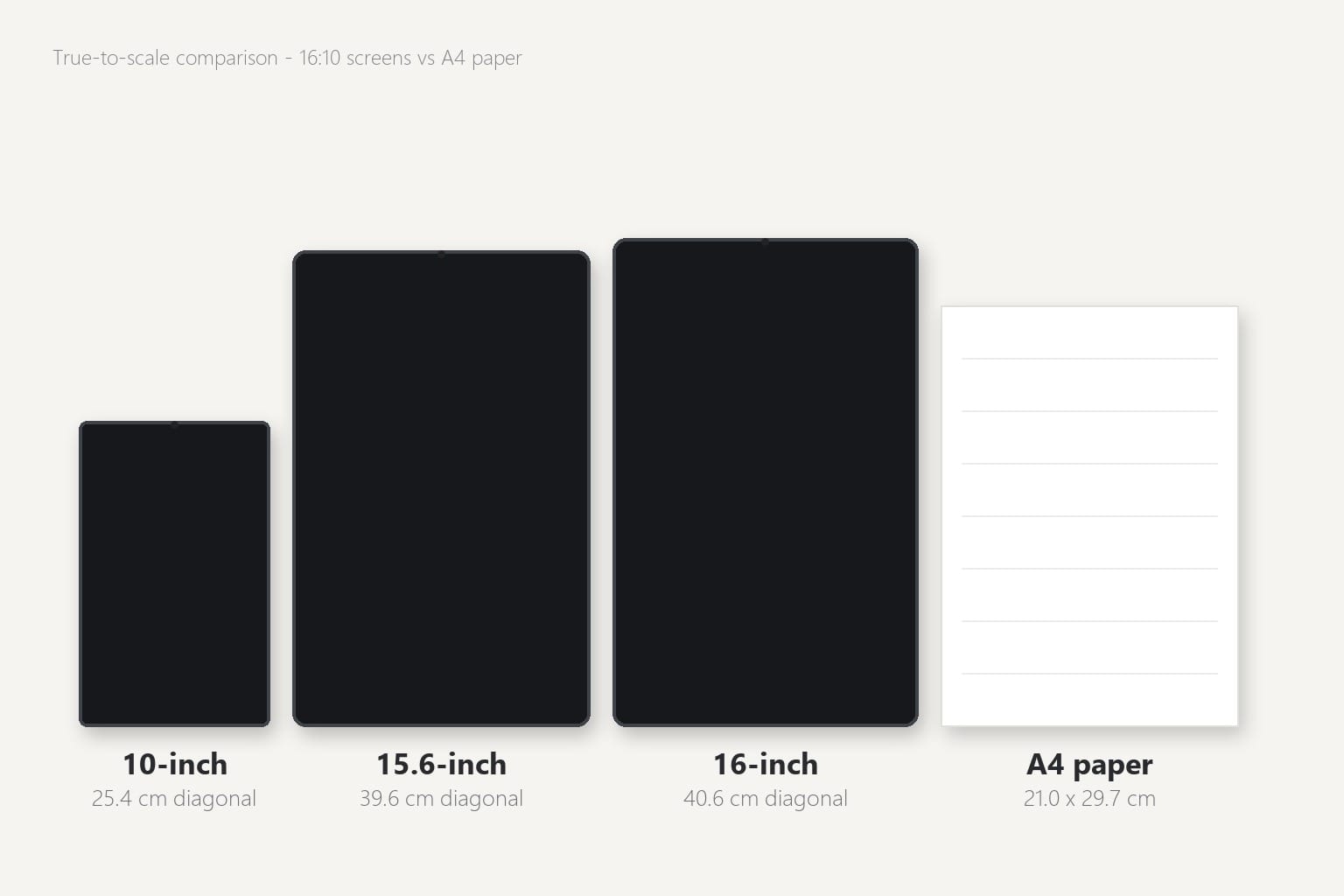
If your real question is how these sizes map onto a physical sheet of paper, our large-screen tablet range lists every size with its physical equivalent.
What’s Bigger Than a Tablet?
Once you cross 16 inches you leave the tablet category, and the options change character.
Portable monitors. These run from about 15.6 to 27 inches and cost far less per square inch of glass than any tablet, but they need a host device and a power source. A 24.5-inch portable monitor has more than twice the area of a 16-inch tablet panel, yet it is not a tablet: no battery, no processor, and no touch-first operating system.
It is also worth naming the category properly: if the goal is a big screen you can carry between rooms rather than a tablet, a portable TV or a portable monitor is the better buy — larger, cheaper per inch, and designed around a wall outlet instead of a battery. It is also, unmistakably, not a tablet.
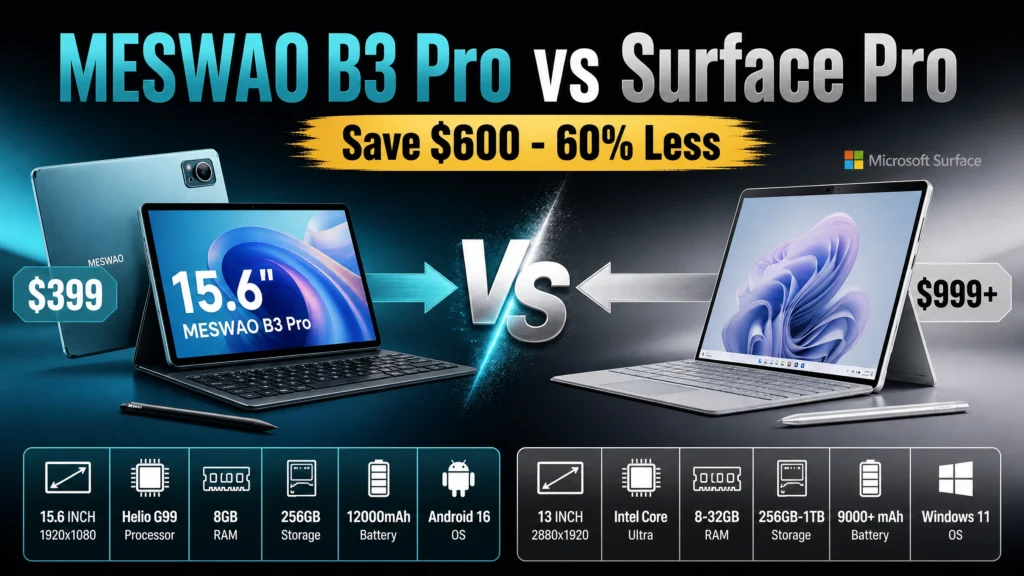
Windows 2-in-1s. Convertibles such as the Surface Pro family sit in the 13-inch bracket with 3:2 panels — a slightly squarer shape than 16:10, and slightly less area than a 13-inch iPad Pro. They are a different answer to the same question, buying flexibility with a desktop OS rather than area.
Commercial digital signage. 32 inches and up, built for always-on operation, wall or floor mounting and multi-year duty cycles. The panel cost per inch is the lowest of any category; the installation and power cost is the highest.
Folding tablets. The unfolded inner display of a book-style foldable is around 8 inches. An impressive piece of hinge engineering and a complete irrelevance if screen area is what you are shopping for.
The historical record. The largest device ever sold as a tablet remains the Panasonic Toughpad 4K UT-MB5: a 20-inch, 3840 × 2560 slate launched in 2014 for around $5,999, weighing 2.35 kg and measuring 12.5 mm thick. It was discontinued without a direct successor, and nothing has claimed its size since. That is about as clear as evidence gets that the 16-inch ceiling is a demand-and-economics ceiling rather than an engineering one.
So the answer to “what is the biggest tablet in the world” depends on the tense. On sale in 2026, it is a 16-inch Android tablet. Ever built, it is a 20-inch Panasonic from 2014 that almost nobody bought twice.
Frequently Asked Questions
What is the largest tablet in the world in 2026?
It is a 16-inch Android tablet. Two models are on sale: the Acer Iconia A16 and the MESWAO B5, with the MESWAO B5 Basic offering the same 16-inch panel at a lower specification. All three have around 742 cm² of screen area, roughly 19 percent more than an A4 sheet. No 17-inch tablet is sold anywhere as of October 2026.
Is there such a thing as a 17-inch tablet?
No. As of 2026 there are no 17-inch tablets on the market, and the largest confirmed tablet size is 16 inches. Above that, manufacturers move to portable monitors and commercial displays, which have no battery and no processor of their own and are designed to be attached to a host device or a wall.
How big is a 16-inch tablet in centimetres?
The panel measures 345 × 215 mm, with a 40.6 cm diagonal. That is slightly more area than an A4 sheet (210 × 297 mm) — about 19 percent more. Remember this is the screen only: a complete device is larger, and the Acer Iconia A16 chassis measures 369.5 × 240.2 mm.
What is the biggest tablet ever made?
The Panasonic Toughpad 4K UT-MB5, a 20-inch 4K tablet released in 2014. At 2.35 kg it was never genuinely portable, it was discontinued without a successor, and it still holds the record for the largest device ever sold as a tablet.
Are 16-inch tablets too big to use every day?
For desk work, no — the panel is only 21 mm taller than the 15.6-inch size it replaces, so it occupies the same footprint on a table. For handheld use, yes: at close to a kilogram, a 16-inch tablet wants a stand or a case with a kickstand. We wrote a separate hands-on answer to is 16 inches too big? if that is your deciding question.
The Short Answer for Buyers
If what you want is the largest screen that is still a tablet, the search ends at 16 inches. The MESWAO B5 (16 GB / 256 GB) and the B5 Basic (12 GB / 128 GB) are both 16-inch 16:10 slates with Widevine L1 support — the B5 is the higher-spec model, and the B5 Basic is the value pick with the identical screen.
If you are comparing across sizes rather than hunting for the maximum, start with our full ranking of large-screen tablets, where 13, 14, 15.6 and 16-inch models are lined up on price, battery life and stylus support. The large-screen tablet range covers every size we build, and 16-inch models compared goes deeper on the 16-inch tier itself.
The shortest version of the answer: 16 inches is the largest tablet in the world today, 20 inches is the largest one ever built, and everything in between is a portable monitor.